Kelling Heath
A Short History of Kelling Heath and Muckleburgh Hill
under the Care of the Kelling Heath Trustees
Prior to 1781, the heathland surrounding the villages of Kelling and Salthouse was considered to be common land and as far as Kelling was concerned included all the area covering Muckleburgh Hill and extending beyond the present railway line up to what is now Kelling Heath Holiday Park.
The people of Kelling had a right to graze their animals and collect firewood on the heath. Government policy under King George III was to enclose common land and withdraw the centuries old rights of villagers to use the heath as common land. Boards of Enclosure Commissioners were established to oversee the enclosure of common lands all over the country and not surprisingly this met with fierce resentment by local residents who usually had little or no land of their own to use as an alternative.
The Commissioners made ‘Awards’ to local land owners who held the lands in trust as owners and to the clergy who then permitted their own tenants to use their land for the grazing of sheep and cattle. The Kelling Heath Award was made by the commissioners in 1781 25 local land owners, including Zurishaddai Girdlestone, the Lord Mayor of Kelling. The Rector of Kelling was also made a trustee. The Award stipulated for the appointment of two Reeves by the Lord of the Manor to be responsible for regulating the grazing of sheep and cattle and they received payment for doing so. Monies arising from the activities on the heath were to be distributed by the Overseers of the Poor in the parish by the Rector and churchwardens as they saw fit. Over the course of the years certain tenants of the Lord of the Manor who were now known as Common-Righters came to receive a dividend from any proceeds arising from rents and charges arising from the use of the heath and these were distributed by the Reeves.
Some one hundred years after the Award was made, railways were being constructed all over the country and a line was built from Weybourne to Holt which had to pass over Kelling Heath.
During the Great War Kelling Heath was used as a training ground for Imperial troops and there is still evidence of some of the trenches and earthworks which were dug on the Heath at that time.
With the onset of the Second World War, the minutes of the meetings of the Trustees show that the Heath was under permanent military occupation as a training area, although not formally requisitioned. A dummy airfield was constructed on an area of the heath south of the railway line. After the war, compensation was sought for the loss of facilities to Common-Righters. Payments were restarted to the Common-Righters after compensation was obtained in 1948.
In 1959 an agreement was reached with the war department to restrict military use of the Heath to 56 days a year and the Ministry of Agriculture became involved in cooperation with the District Rabbit Clearance Society to control the damage done by rabbits to the heath vegetation.
By the sixties all the main elements of the management of the heath were in place. Income was derived from payments by the Charity Commissioners on the Consols which had been received from the construction of the railway, the Ministry of Defence paid a regular rent for use of the heath for military training exercises and the Ministry of Agriculture was involved in preserving the heath from the depredations of rabbits.
In 1990 the Kelling Fuel and Pasture Charity, as the Kelling Heath Trustees was now formally known, entered into a ‘Scheme’ with the Charity Commissioners which laid down the formal arrangements for the new charity. This meant the land became officially vested in the official custodian for charities with the interest being held in trust for the charity. There are seven trustees: the Lord of the Manor and the Rector ex officio; 3 trustees nominated by the Kelling Parish Council and two co opted trustees. The trustees authorised to apply the income of the Charity to relieve either generally or individually, persons resident in the Parish of Kelling who are in conditions of need, hardship or distress by making grants of money or providing or paying for items, services or facilities calculated to reduce the need hardship or distress of such persons.
The land under the jurisdiction of trustees amounts to an area of 150 acres and 34 perches.
In 1992 the trustees entered into a countryside stewardship agreement with the Countryside Commission (now the Defra) to promote schemes designed to conserve or enhance the natural beauty or amenity of the countryside or to help people enjoy it. Works such as the clearance of gorse and the sowing of heather seed are carried out in return for an annual grant from the Defra. The programme has been a great success and terminated in 2002.
A further ten year Stewardship Agreement was entered into from 2002 to 2012, and then followed by a ten year Higher Level Stewardship Agreement, which has currently been extended by up to a further five years. It is hoped that Defra will be introducing a new scheme in 2025, which will suit the needs of heathland management more closely.
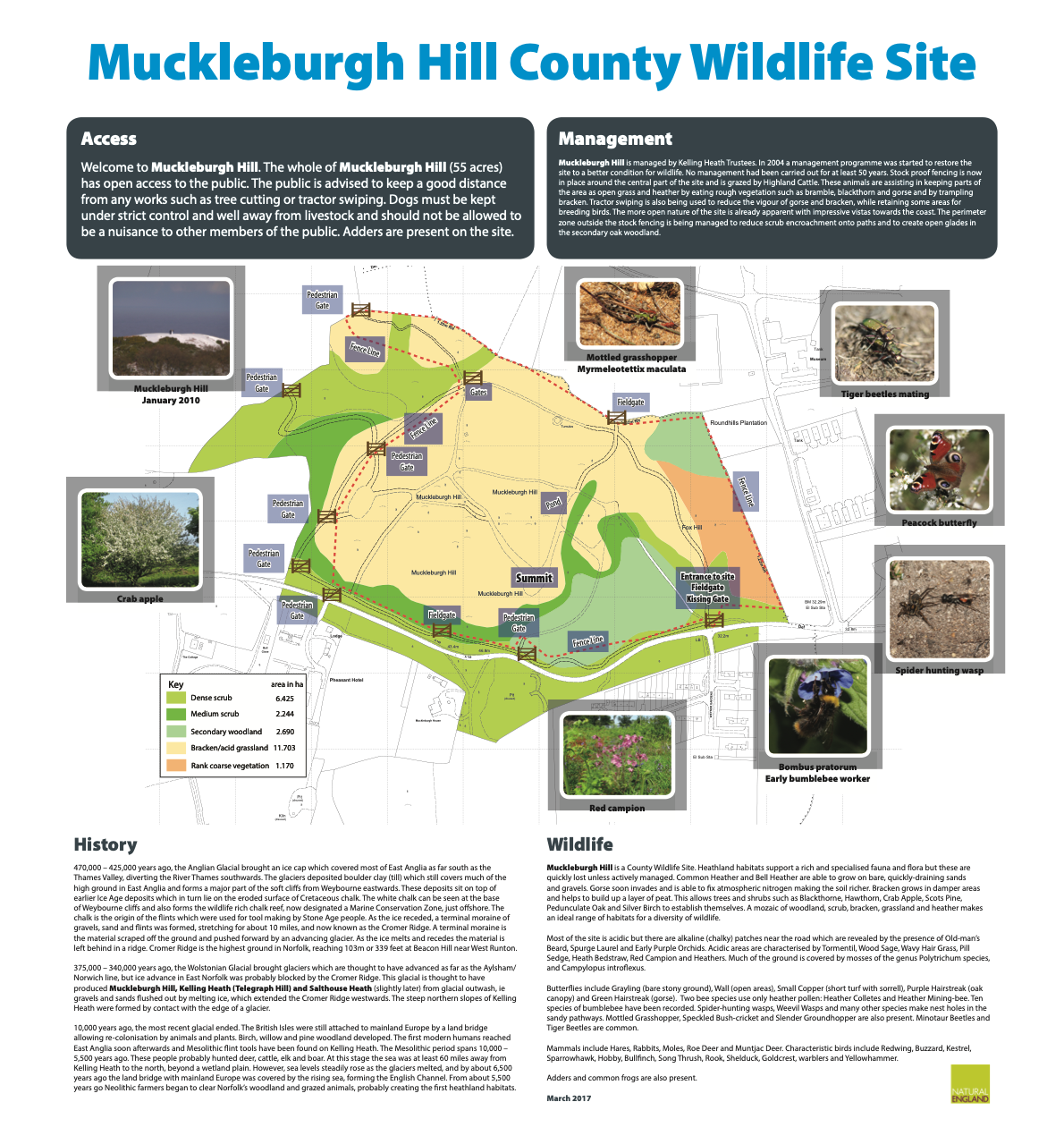
During the 32 years of the Stewardship Agreements, large areas of both Kelling Heath and Muckleburgh have been cleared of excessive scrub, mostly gorse and trees, mostly silver birch. Stock fencing was erected on Muckleburgh in about 2004,and the area has been grazed since by cattle.
With thanks to A. Chapman
Click here for a pdf version of this article